-

Don't be a dotard!
Read these "rules" AND introduce
yourself before your first post - Dismiss Notice
- Dismiss Notice
Super Best Audio Friends
The evolution of the original irreverent and irrelevant and non-authoritative site for headphone measurements, i.e. frequency response graphs, CSD waterfall plots, subjective gear reviews. Too objective for subjectivists; too subjective for objectivists
Violectric V324 - A worthy successor to the V281
Pros: The sound!! Also the very practical, compact form factor, useful I/O controls and attractive faceplate
Cons: Silver not available; remote control not bundled with the amp
...
Enter the V324
I heard Violectric’s new V324 at an audio show several months back. I liked the sound right away. It was what I think of as the “Violectric house sound” – powerful, slightly warm, with strong bass, realistic weight in the lower registers, tuneful, flowing midrange and treble, strong dynamics, and a pleasing reproduction of the spatial qualities of recorded music. Recently I got my hands on a loaner V324, which will be the subject of this review.
Thanks to Arthur Power of Power Holdings Inc. for supplying the loaner V324 and answering many questions about it.

Pros: The sound!! Also the very practical, compact form factor, useful I/O controls and attractive faceplate
Cons: Silver not available; remote control not bundled with the amp
...
Enter the V324
I heard Violectric’s new V324 at an audio show several months back. I liked the sound right away. It was what I think of as the “Violectric house sound” – powerful, slightly warm, with strong bass, realistic weight in the lower registers, tuneful, flowing midrange and treble, strong dynamics, and a pleasing reproduction of the spatial qualities of recorded music. Recently I got my hands on a loaner V324, which will be the subject of this review.
Thanks to Arthur Power of Power Holdings Inc. for supplying the loaner V324 and answering many questions about it.
Schiit Mimir F #2 technical measurements
Several manufacturers have pushed boundaries in performance when developing their statement components. Some have then endeavored to apply what they have learned to lower end models in their respective lines often narrowing the gap in both measurement performance and listening enjoyment between high and lower cost products. Schiit’s Mimir F is an excellent example of this trend offering impressive measurement performance but more importantly consistently enjoyable listening experiences.
Listening evaluation example

Merc 3b, Mimir F, Vali 3 with GE5670W tube, ETA Ada headphones.
I feel so strongly about the importance of this product development that I bought, measured and put out on tour this specific DAC, thus #2 on the loaner tour. Measurements presented are for this specific DAC:
https://superbestaudiofriends.org/index.php?threads/loaner-mimir-f.15459/
Several manufacturers have pushed boundaries in performance when developing their statement components. Some have then endeavored to apply what they have learned to lower end models in their respective lines often narrowing the gap in both measurement performance and listening enjoyment between high and lower cost products. Schiit’s Mimir F is an excellent example of this trend offering impressive measurement performance but more importantly consistently enjoyable listening experiences.
Listening evaluation example
Merc 3b, Mimir F, Vali 3 with GE5670W tube, ETA Ada headphones.
I feel so strongly about the importance of this product development that I bought, measured and put out on tour this specific DAC, thus #2 on the loaner tour. Measurements presented are for this specific DAC:
https://superbestaudiofriends.org/index.php?threads/loaner-mimir-f.15459/
Limited Comparison of Bench Power Supplies’ residual noise
A staple of electronic design is one or more lab bench power supplies. There are many available from very inexpensive to uber expensive. The lower price range is dominated by SMPS while higher end models are often linear designs. Datasheet specifications vary considerably in the information disclosed. Noise specifications are at best a numeric ripple & noise value. Nowhere to be found are noise spectrums. This comparison will address that for the selected power supplies.

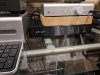
Left to right bottom linear type:
Korad KA6003P
B&K Precision 1730A
Keysight U8001A
Left to right (on top of U8001A) SMPS type:
Hanmatek HM305
Kiprim DC310S
BK 1730A is a full on old school analog linear bench supply. Analog meters. All passive cooling, no fan, no acoustic noise.
DC310S has the greatest number of display features including ability to track voltage or current over time which makes it very useful for educational purposes.
A staple of electronic design is one or more lab bench power supplies. There are many available from very inexpensive to uber expensive. The lower price range is dominated by SMPS while higher end models are often linear designs. Datasheet specifications vary considerably in the information disclosed. Noise specifications are at best a numeric ripple & noise value. Nowhere to be found are noise spectrums. This comparison will address that for the selected power supplies.
Left to right bottom linear type:
Korad KA6003P
B&K Precision 1730A
Keysight U8001A
Left to right (on top of U8001A) SMPS type:
Hanmatek HM305
Kiprim DC310S
BK 1730A is a full on old school analog linear bench supply. Analog meters. All passive cooling, no fan, no acoustic noise.
DC310S has the greatest number of display features including ability to track voltage or current over time which makes it very useful for educational purposes.
My desktop DAC has been a Yggdrasil A2 for the last three years or so and I have been happy with it, but recently I wanted to try a different source, perhaps something a touch more neutral yet similarly detailed and resolving. I enjoyed the Holo Spring 3 KTE that was on tour here at SBAF a couple of years ago (my review here). At the time I stated that for my preferences that DAC would (mostly) be a side grade - a trading of one set of strengths for a different set.
The Holo Cyan 2 is Holo's lowest tiered and priced DAC and costs less than half of a new Spring 3 KTE (and about $1K less than a new Yggdrasil). How does it stand up against it & the TOTL Schiit DAC?
Pics or did not happen:

The Holo Cyan 2 is Holo's lowest tiered and priced DAC and costs less than half of a new Spring 3 KTE (and about $1K less than a new Yggdrasil). How does it stand up against it & the TOTL Schiit DAC?
Pics or did not happen:
UPDATE: measurements on IEC711 clone here
![[IMG]](https://i.imgur.com/kEGzsRE.jpg)
EXECUTIVE SUMMARY: Thrown-forward headstage that's more defined on either side than in the center, but with good imaging. Somewhat of a bit of romantic decay to things, which is more to my preference. Bass is still more elevated than I'd like but it's less egregious in the low bass than the Zero:2 was, but the treble on these is pretty unrefined and may need a more sedate sounding source or even EQ to fit a lot of folks. These seem sensitive to impedance, things sound a bit hollower out of a 1.2R source than out of a near-0 ohm one, but I'm unsure...
These are the Grado Labs HP100 SE but with the new pads. I'm not sure what they are to be named EDIT, they are the B cushions). The are like the flat F pads, but extended to the diameter of the big G "salad bowl" cushions. I found the F cushions to be a bit uncomfortable for longer listening sessions. Also, with the F cushions, I felt the made the HP100 SE sound subjectively too dark - this is regardless of measurements, or maybe I am losing my high frequency hearing (which could be the case). While the G cushions were too bright, the B cushions are PERFECT!

The latest pads seem to do the trick. Here's a sneak preview. I will return later to provide more technical analysis. The latest pads seem to do the trick. Here's a sneak preview. I will return later to provide more technical analysis. Distortion surfaces, CSDs, attack and and decay burst envelopes.
The latest pads seem to do the trick. Here's a sneak preview. I will return later to provide more technical analysis. The latest pads seem to do the trick. Here's a sneak preview. I will return later to provide more technical analysis. Distortion surfaces, CSDs, attack and and decay burst envelopes.
OK, maybe not quite fair because the latest iteration of the Allnic is the H-1202 which is twice the price of the Stjarna. To be real, the Stjarna is quite a good jump from the lower line Schiit phono pres, the Skoll and Mani 2. My very positive initial impressions can be found here: https://www.superbestaudiofriends.org/index.php?threads/schiit-stjarna-tube-phono-pream.14943/

By itself, the Stjarna honestly is really good. However, what we do on SBAF is compare, and that means sometimes comparing to known bests within a price range. Hometheaterhifi.com says that the Stjarna is a giant killer. I would have to disagree. Now the Stjarna goes come with a crazy set of features found on very expensive phono preamps, namely its remote adjustability via the Forkbeard app (iOS initially and now available on Android) with respect to setting capacitive and resistive loads as well as gain; but at the end of the day it comes down to sound. The Stajrna is good, it's worth its asking price, but it's not a giant killer.
By itself, the Stjarna honestly is really good. However, what we do on SBAF is compare, and that means sometimes comparing to known bests within a price range. Hometheaterhifi.com says that the Stjarna is a giant killer. I would have to disagree. Now the Stjarna goes come with a crazy set of features found on very expensive phono preamps, namely its remote adjustability via the Forkbeard app (iOS initially and now available on Android) with respect to setting capacitive and resistive loads as well as gain; but at the end of the day it comes down to sound. The Stajrna is good, it's worth its asking price, but it's not a giant killer.
NoiseNuke™ version C SMPS noise suppressor technical measurements
NoiseNuke™ version C:

Another variant of the original NoiseNuke™ SMPS noise suppressor. This one has a much larger choke value while a smaller electrolytic capacitor value. It is restricted to a maximum current of 1A. However it retains the maximum voltage of 50Vdc recommended limit. With a smaller electrolytic there is less energy storage available to potentially destroy downstream components from inrush current during their power on cycle. NoiseNuke++ required an output choke for this reason. The original was borderline for higher voltage power supply systems.
NoiseNuke™ version C:
Another variant of the original NoiseNuke™ SMPS noise suppressor. This one has a much larger choke value while a smaller electrolytic capacitor value. It is restricted to a maximum current of 1A. However it retains the maximum voltage of 50Vdc recommended limit. With a smaller electrolytic there is less energy storage available to potentially destroy downstream components from inrush current during their power on cycle. NoiseNuke++ required an output choke for this reason. The original was borderline for higher voltage power supply systems.
Anyhow, I started wondering if the room treatment money may be better reallocated towards some speakers that are more room-agnostic, i.e. something with more controlled directivity. Now, I've been paying attention to Erin's Audio Corner's reviews for a good bit now, and when the ASCILab review showed up they seemed like a great bargain for a VERY well measuring controlled directivity speaker. These also piqued my interest as I've always wanted to hear what a nearly "perfectly" measuring speaker sounds like.
Problem was, they were out of stock with no new stock expected for several months. Some googling and googling and googling led me to a somewhat horrific pill - it seemed that future U.S. distribution for ASCILab was to be handled by Amir. Yeah, that Amir.
![[IMG]](https://i.imgur.com/O2Mdk0v.jpeg)
Problem was, they were out of stock with no new stock expected for several months. Some googling and googling and googling led me to a somewhat horrific pill - it seemed that future U.S. distribution for ASCILab was to be handled by Amir. Yeah, that Amir.
Violectric is a brand name we’ve been familiar with for a while now. The Violectric V281 (and its DAC-less variants) sat on my recommended list of solid-state amps for the HD800—and many other headphones—for quite some time. Eventually, the V281 fell off the list simply because better gear emerged. In the meantime, Violectric released newer models to supersede their old standbys, replacing the V281/V280 with the V324/V222 respectively.

Admittedly, SBAF has had its head in the sand regarding Violectric for the past few years. Since the brand is based in Germany, we haven't had a direct line to them. I only reconnected with them at the recent CanJam Dallas. (You can read my show impressions here: https://www.superbestaudiofriends.org/index.php?threads/canjam-dallas-2025-show-report.15340/
Between the V324 and the V222/V228, the latter is the more neutral-sounding option. Note that the V222 is the pure amp, while the V228 includes a DAC. I hope to get the V324 in for review later—donations are appreciated, as we've lost a few sponsors over the years.
Admittedly, SBAF has had its head in the sand regarding Violectric for the past few years. Since the brand is based in Germany, we haven't had a direct line to them. I only reconnected with them at the recent CanJam Dallas. (You can read my show impressions here: https://www.superbestaudiofriends.org/index.php?threads/canjam-dallas-2025-show-report.15340/
Between the V324 and the V222/V228, the latter is the more neutral-sounding option. Note that the V222 is the pure amp, while the V228 includes a DAC. I hope to get the V324 in for review later—donations are appreciated, as we've lost a few sponsors over the years.
The Grell OAE1 headphones are a new product designed by Axel Grell, formerly the chief engineer at Sennheiser and now the founder/owner of Grell Audio. They feature an unconventional structure where the drivers are positioned significantly in front of and away from the ears. This design choice appears to be aimed at minimizing pinna interactions and potentially enhancing spatial representation of sound. The intention seems to be to achieve a more natural and realistic audio reproduction.
![[IMG]](https://i.imgur.com/MAujpWW.jpg)
Although I was not 100% sure if his claims are legit, as a huge fan of non-traditional acoustic designs, I was highly tempted to get my hands on the pair, expecting something at least different if not necessarily better. After weeks of waiting after pre-order was placed, I finally received the product this morning and spent approximately 6 hours evaluating them...
Although I was not 100% sure if his claims are legit, as a huge fan of non-traditional acoustic designs, I was highly tempted to get my hands on the pair, expecting something at least different if not necessarily better. After weeks of waiting after pre-order was placed, I finally received the product this morning and spent approximately 6 hours evaluating them...
To my knowledge, the ZMF Aegis is essentially a DIY project that Zach liked enough to produce himself (both legally and ethically, Zach ain't that type of dude). It's quite an interesting thing, using a pair of EL34 tubes, a pair of 6SL7, and a 5AR4 rectifier, with it being a cathode follower design. The cathode follower part is interesting to me because from my knowledge this is more of a guitar tube amp thing, where a cathode follower allows for a smoother overdrive, has lower output impedance, and is less affected by the load compared to the standard plate driven designs. The downside to this is that it produces less gain, but in the modern world of sky high DAC outputs and more sensitive headphones, this is probably actually an upside (at least in the world of audio playback)!

I usually talk about features and stuff later on in the review (because come on, a quick Google search gives you the skinny on all features and really what people want to read is how it sounds), but I do want to bring up one note here. The impedance switch noticeably changes the amp's character, with low being the most restrained and polite, and high being kind of bombastic and slamming
I usually talk about features and stuff later on in the review (because come on, a quick Google search gives you the skinny on all features and really what people want to read is how it sounds), but I do want to bring up one note here. The impedance switch noticeably changes the amp's character, with low being the most restrained and polite, and high being kind of bombastic and slamming
Page 1 of 41
XenPorta 2 PRO
© Jason Axelrod from 8WAYRUN
